Bayern Munich Reaches 500,000 Members, a World Record for a Sports Club
Baca dalam 60 detik
- Bayern Munich resmi menjadi klub olahraga dengan anggota terbanyak di dunia setelah mencapai 500.000 anggota pada rapat umum tahunan 2026.
- Pertumbuhan anggota Bayern melampaui Benfica dan klub-klub besar Jerman lain, mencerminkan model kepemilikan fans yang khas Bundesliga.
- Dominasi Jerman dalam daftar klub dengan anggota terbanyak menegaskan kekuatan sepak bola akar rumput di negara tersebut.
Bayern Munich has made history as the sports club with the largest membership in the world. At its 2026 annual general meeting, the Bavarian club announced it now has 500,000 official members, surpassing its previous milestone and cementing its position atop the list of football clubs with the largest fan base.
The figure has risen sharply compared with previous years. In February 2025, while celebrating its 125th anniversary, Bayern claimed 400,000 members—matching Benfica of Portugal. A year earlier, the number stood at 382,000. The addition of 100,000 members in a single year shows remarkable acceleration, especially amid increasingly fierce competition among European clubs.
Bayern President Herbert Hainer called the half-million members the "foundation on which everything is built". The statement underscores that for Bayern, members are not merely a number but part of the club's identity and community strength. The demographic data is also striking: the average member age is 36, nearly a quarter are under 18, and around 70,000 people have been members for at least two decades. They are spread across 152 countries, with the largest concentrations after Germany in Austria, Switzerland, the United States, Luxembourg, and the United Kingdom.
Bayern now sits far ahead of Benfica, which has 440,000 members. Below them, Argentine clubs River Plate (352,712) and Boca Juniors (282,644) complete the top five. Notably, Schalke 04—a club that spent three seasons in the second division—reached 220,000 members in July 2026, ranking sixth in the world. The achievement shows that the fan base of German clubs does not always correlate with on-pitch success.
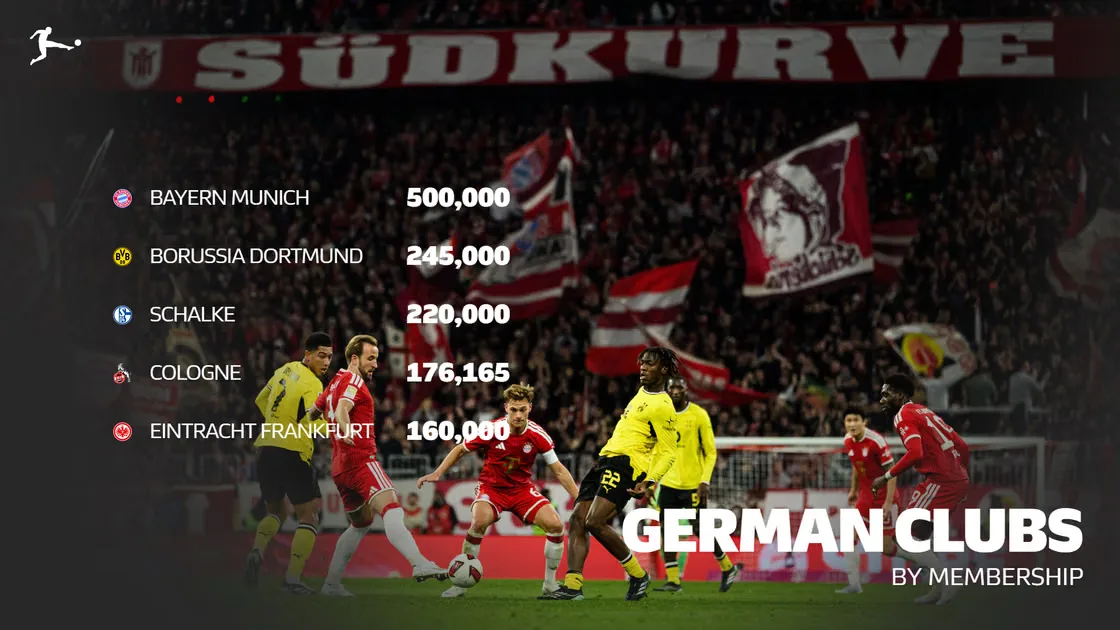
Germany's dominance on this list is no coincidence. The ten clubs with the most members in Germany include Bayern, Dortmund (245,000), Cologne (176,165), Eintracht Frankfurt (160,000), Hamburg (150,000), VfB Stuttgart (135,000), Borussia Mönchengladbach (111,250), Freiburg (85,000), and Union Berlin (71,958). The phenomenon is tied to the 50+1 rule, which requires clubs to be majority-owned by their members, giving fans a voice and a strong emotional attachment.
"Around 78 percent of new members say they want to be part of the Bayern family. Community matters as much as sporting success, and our club upholds values and takes a stand," Hainer said in November 2023.
The fan-engagement model is not just about numbers. Union Berlin, for instance, had their stadium rebuilt by fans in 2008, and in 2011 fans were given the chance to own shares in the Alte Försterei. Schalke launched a registered cooperative at the end of 2024, allowing fans to buy shares and gain voting rights. Meanwhile, Mainz 05 has held regular club-fan dialogues since 2022, and Freiburg set up a fan advisory board in 2023 to maintain communication amid membership growth.
Membership growth is also spread across other clubs. Hertha Berlin has recorded nearly 17,000 new members since 2022, Werder Bremen reached 64,000 members in 2025—more than 1,000 of them lifetime members—and Mainz broke through an average attendance of 30,000 in the 2023/24 season. For these clubs, the membership surge is not just symbolic but also a source of stable revenue and social legitimacy.
Looking ahead, the challenge is to maintain the quality of engagement amid rapid growth. Bayern and other German clubs need to ensure that member communication and participation are not eroded by ever-larger scale. If successful, this model could serve as a reference for clubs in other leagues—including in Indonesia—that want to build a loyal and sustainable fan base. The question is, can Asian clubs replicate this community-based approach?