SFO Airport Manages 54 Million Passengers With a 'Digital Twin', a Lesson for Indonesia?
Baca dalam 60 detik
- San Francisco International Airport memakai living digital twin untuk mengelola 100 gedung dan 18 juta kaki persegi area indoor di tengah proyek renovasi senilai US$11 miliar.
- Teknologi ini menggabungkan BIM dan GIS sehingga setiap titik data terikat lokasi presisi, memungkinkan deteksi dini gangguan operasional sebelum menjadi krisis.
- Pendekatan serupa berpotensi diadopsi bandara Indonesia seperti Soekarno-Hatta dan I Gusti Ngurah Rai untuk menekan risiko ekspansi tanpa menghentikan layanan.
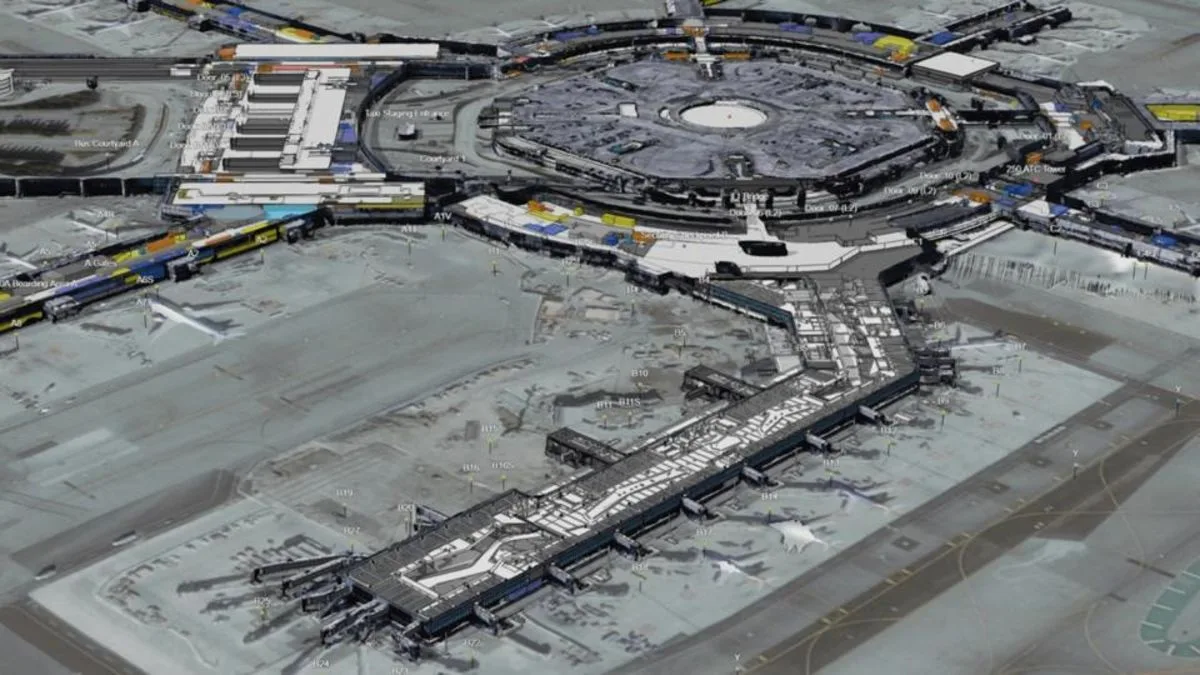
San Francisco International Airport (SFO) proves that airport modernization does not have to mean chaos. Amid an US$11 billion capacity expansion project, the airport that serves 54 million passengers a year keeps operating at full capacity thanks to a living digital twin—a virtual replica that is continuously updated and connected directly to field conditions.
The digital twin at SFO is not merely a static 3D model. The system unites Building Information Modeling (BIM) with location data from a Geographic Information System (GIS), then adds live sensor feeds and operational information. As a result, airport managers can view the contents of every building layer by layer—from rooftop solar panels to underground utility networks—while predicting what will happen next.
According to Josephine Young, SFO's Director of Infrastructure Information Management, the digital twin serves as a "front door" for every work unit at the airport. "Users can see the inside of a building in layers, from solar panels to underground utilities," she said, as quoted from an official statement.
What makes this system crucial is the scale of its operations. SFO manages more than 100 buildings across an area of eight square miles, with total indoor space exceeding 18 million square feet. Every system—customs, security, baggage, ground transportation—must run efficiently without interfering with one another. The digital twin allows operations teams to plan major changes, such as terminal renovations or new routes between baggage claim and public transportation, while scheduling preventive maintenance such as lamp replacement or pipe upgrades.
The biggest test comes when SFO executes large-scale construction projects. Every phase of work affects security checkpoints, utilities, baggage handling, and passenger flow—each with the potential to trigger cascading disruptions. With the digital twin, teams can test changes in the virtual world before applying them in the field. Contractors, operations teams, security officers, and airlines work from a single shared source of truth. Problems that usually surface only when critical can appear earlier as design questions, not operational emergencies.
As a result, airlines keep operating, passengers keep moving, and capital stays productive while it is being spent. The digital twin turns change coordination into a controlled process, not a series of costly shutdowns.
The key strength of this system is its closeness to location. Without geographic data, the digital twin cannot model how passenger congestion in one area triggers queues at security checkpoints, or how delays in cargo unloading affect logistics inside and outside the airport. Geography becomes the connective network that brings the whole system to life.
Going forward, SFO continues to develop its digital twin capabilities as automation and artificial intelligence advance. Its team has just built an automated workflow that integrates BIM models into the enterprise GIS, covering not only architecture but also mechanical, electrical, and plumbing systems. The immediate benefit is a more complete and continuously evolving view of infrastructure. The bigger shift: data from design and construction retains value after a project is finished, available to support operations and asset management.
The relationship between SFO and its digital twin is mutually reinforcing. The airport changes, and the digital twin reflects that change. Location data helps airport officials manage change and plan the next step. This positive feedback loop promises dividends for SFO—and for any organization intent on adapting to a future full of challenges.
For Indonesia, this approach offers a valuable lesson. Soekarno-Hatta and I Gusti Ngurah Rai airports face a similar challenge: capacity expansion amid unrelenting service demands. Adopting a GIS-based digital twin can help managers map risks, test change scenarios, and maintain operational continuity. The question is whether domestic airport operators are ready to invest in data infrastructure capable of changing how they manage complexity.