AMD Opens Lux Supercomputer: 4,000 GPUs for Science, Half the Time for Sale
Baca dalam 60 detik
- Superkomputer Lux resmi dioperasikan untuk pengguna ilmiah setelah debut di peringkat 14 TOP500 dengan 220,79 petaflops.
- Separuh dari 3,5 juta node-hour tahunan dialokasikan untuk Genesis Mission, sisanya diperdagangkan secara komersial.
- Kesuksesan Lux akan diukur dari hasil riset fusi dan prediksi cuaca, bukan sekadar skor benchmark.
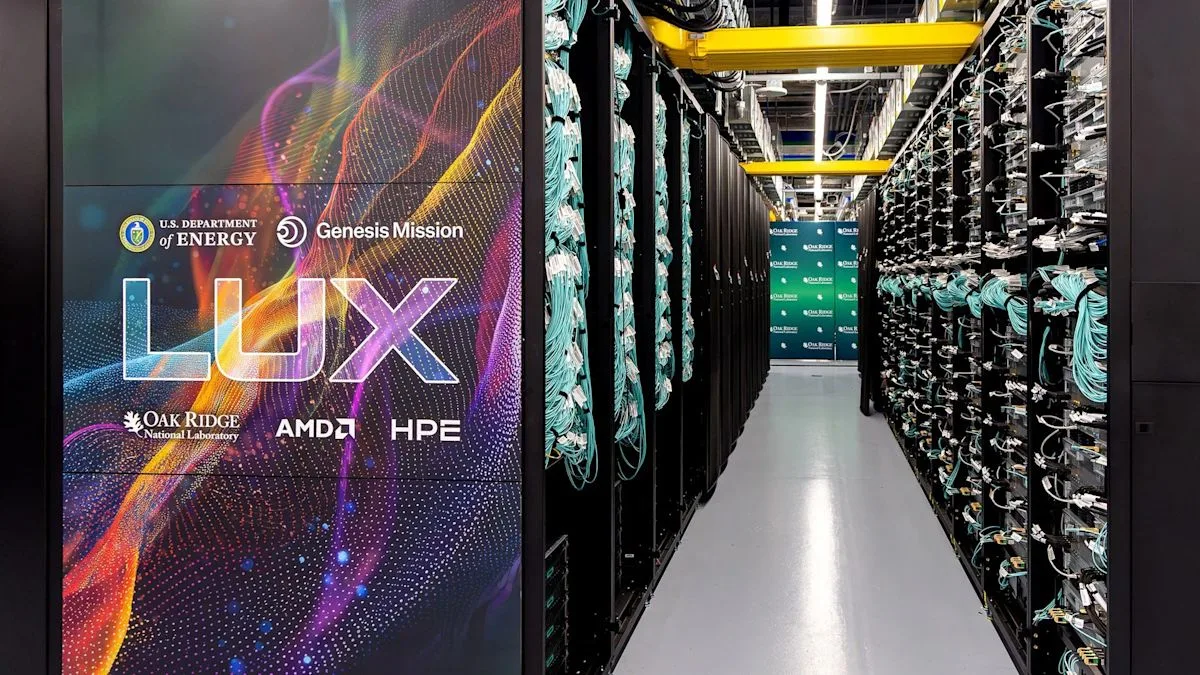
The Lux supercomputer, a collaboration between AMD and the US Department of Energy at Oak Ridge National Laboratory (ORNL), is now officially open to scientists. The system ranks 14th on the November 2026 TOP500 list with 220.79 petaflops, making it the first "AI Factory" infrastructure dedicated to the Genesis Mission—an artificial intelligence-driven science acceleration program.
Lux is built with more than 500 compute nodes, each powered by eight AMD Instinct MI355X GPUs. In total, there are about 4,000 GPUs with 288GB of HBM3E memory per unit, equivalent to 1.1 petabytes of HBM across the system. Inter-GPU networking uses 800G Ethernet from HPE Juniper, while storage relies on Orion, a 600PB Lustre file system previously developed for Frontier.
Even so, Lux's main appeal is not just its hardware specifications. Its business model is unusual for a government research facility. Of the 3.5 million node-hours available each year, half is allocated to Genesis Mission projects, while the rest is sold for proprietary use at DOE user facility rates. The minimum commitment is set at 175,000 node-hours per six months, with project durations ranging from six months to five years. AMD itself will use part of that paid time for internal research and testing, and plans to offer slots to new partners.
On the scientific side, Lux has been assigned three inaugural projects under the Genesis Mission. First, FADO (Fusion Agentic Design Orchestrator), an agentic AI workflow that combines design simulation, robotics, and maintenance planning to accelerate the design of fusion power plants. ORNL argues that reliability, availability, maintainability, and inspection factors are often overlooked in conventional high-fidelity models, even though all four determine whether the first fusion plant can be economical.
Second, a foundation model factory for materials and advanced manufacturing, aimed at producing specialized models to design the microstructure of 3D-printed metal alloys. Third, a long-range water prediction project: forecasting water availability, river discharge, and river temperature on timescales from weeks to years, to support hydroelectric and thermoelectric plants in the Tennessee Valley Authority region.
"Lux shows what can be achieved when national laboratories, government, and industry work together," said Thomas Zacharia of AMD, as quoted in the official announcement.
There is some truth to that statement. Since being announced as part of a US$1 billion investment package for Lux and its successor, Discovery, the system has been built, entered the TOP500 ranking, and opened to users in about one year. However, its schedule slipped from an initial target of 2026 to mid-November. A delay of a few months for a machine this size is reasonable, but it comes amid growing scrutiny from regulators, politicians, and investors over AI computing deals in the US.
What has yet to be seen is the scientific evidence. The fusion, materials, and water projects are only about to begin, and the real benchmark is whether the three can produce findings that would be impossible to obtain from Frontier—the neighboring supercomputer that has trained trillion-parameter models with previous-generation AMD GPUs. Lux does excel in low precision for AI (40 exaflops FP4, 20 exaflops FP8), but its HPL efficiency is about 70% of its 317 petaflops FP64 peak, slightly better than El Capitan (64%) and Frontier (66%).
For Indonesia, AMD's move signals that competition in AI infrastructure is no longer just about chips, but about research ecosystems and access business models. If Lux proves able to generate innovations in materials and energy, developing countries including Indonesia could become users of its research outputs—for example, water prediction models for hydropower plants or battery materials—without having to own a supercomputer. However, dependence on foreign platforms remains a challenge of its own.
Going forward, attention will shift to Discovery, scheduled to arrive in 2028 with EPYC "Venice" CPUs and MI430X GPUs on the HPE Cray GX5000 platform. The question is whether Lux can prove that the US$1 billion public investment produces a real scientific leap, or whether it will merely serve as a showcase of AMD's capabilities on the exascale computing stage.