New Brexit Deal: UK-EU Food Trade Flows More Smoothly, but Customs Still Loom
Baca dalam 60 detik
- Inggris dan Uni Eropa sepakat menyelaraskan aturan produk agri-food, menghapus pemeriksaan di perbatasan Laut Irlandia mulai 2028.
- Dunia usaha menyambut baik pengurangan birokrasi, namun sektor logistik dan energi masih menanti kepastian lantaran kesepakatan listrik belum tercakup.
- Pemerintah Inggris dan UE berkomitmen menuntaskan negosiasi listrik pada 2027, sementara implikasi politik di Irlandia Utara tetap menjadi taruhan.

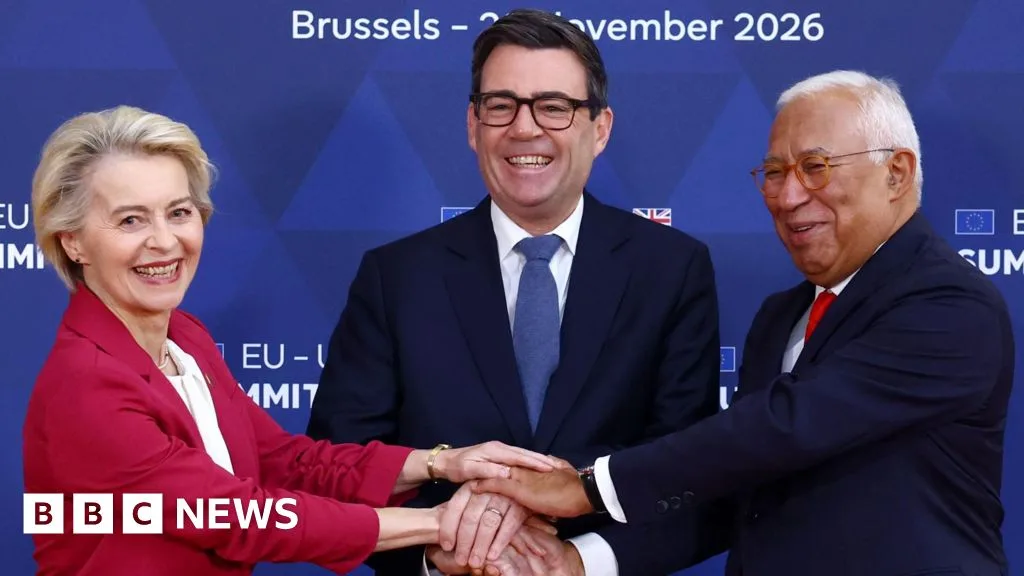
The UK government and the European Union have formally signed a new agreement governing trade in food, plant, and animal products, a step that Northern Ireland's Agriculture Minister, Andrew Muir, called "a big step in the right direction" even though it does not immediately resolve all the issues. The deal, confirmed last Friday at a meeting between Prime Minister Andy Burnham and European Commission President Ursula von der Leyen in Brussels, will realign the whole of the UK with EU rules for agri-food products, so that goods shipped from Great Britain to Northern Ireland no longer pass through port checks.
Since Brexit, Northern Ireland has remained subject to EU regulations for agri-food products, while other parts of the UK have not. This created what is known as the "Irish Sea border"—a series of checks and controls on goods entering Northern Ireland from Great Britain. For nationalists, the arrangement is a necessary compromise to keep the border open with the Republic of Ireland; for unionists, it is a constitutional grievance seen as weakening Northern Ireland's position within the UK. This tension led the Democratic Unionist Party (DUP) to suspend the power-sharing government in 2022–2024 as a form of protest.
The new agreement takes a model similar to the Swiss-EU relationship. Switzerland, which is not an EU member, applies EU rules almost entirely for agri-food trade without regulatory border controls, with the consequence that it must adjust its national laws whenever regulations change in Brussels and accept oversight by the European Court of Justice. The UK is taking a similar path: from March 2028, sea border controls for food products from Great Britain to Northern Ireland will cease, many inspection posts at Northern Ireland ports will fall into disuse, and the "Not for EU" label on food products will no longer be required. However, pre-Brexit checks on livestock will continue.
Nevertheless, the business community's euphoria needs to be framed with critical notes. The Irish Sea border actually consists of two layers: product standards and customs. This agreement does remove the standards layer, but the customs layer is entirely untouched. That means businesses in Great Britain still have to file customs declarations for goods sent to Northern Ireland, and the risk of delays due to incorrect documents remains. For companies operating across the island of Ireland, this administrative burden remains a thorn in the side.
"I think this is only halfway to what we had hoped for," Andrew Lynas, Director of Lynas Foodservice, told BBC NI, calling the deal "a big step forward" while still voicing concern about how long implementation will take.
From the retail side, Retail NI Chief Executive Glyn Roberts called the agreement "a light at the end of the tunnel" after years of facing supply difficulties from Great Britain. Similarly, Northern Ireland Chamber of Commerce Chief Executive Suzanne Wylie said the reduction in checks and certification will cut costs and slash paperwork. She also welcomed progress on linking emissions trading schemes and commitments on steel, but warned that businesses are now waiting for technical details and assurances that both sides will move quickly to deliver the promised benefits.
What is absent from this package is no less important: the electricity agreement. Northern Ireland's energy regulator estimates that re-linking the UK and EU electricity grids could cut wholesale electricity prices in Northern Ireland by up to 20%. However, Brussels insists that an electricity deal must include a financial contribution from London, and negotiations are still ongoing. In a joint statement, both sides pledged to complete talks in 2027 so that all arrangements can take effect as soon as possible.
For Indonesia, this development is worth watching as a mirror of how a non-EU country can enjoy market access without regulatory barriers, but at the cost of losing some sovereignty in setting standards. The UK-EU agreement also confirms that modern trade integration is no longer just about tariffs, but about regulatory alignment and mutual trust. As Jakarta continues to push for the completion of the Comprehensive Economic Partnership Agreement (CEPA) with the European Union, the lesson from Northern Ireland is that real benefits only materialize when border bureaucracy—both for goods and documents—is genuinely simplified.
Going forward, the big question is no longer whether this agreement will reduce trade friction, but how quickly it will be implemented and whether the UK and EU can maintain momentum to complete the delayed electricity package. Without that, the promise of post-Brexit economic recovery in Northern Ireland will still move half-heartedly.